Johannes Segogela
Figures in Communion
14 - 21 February 2026
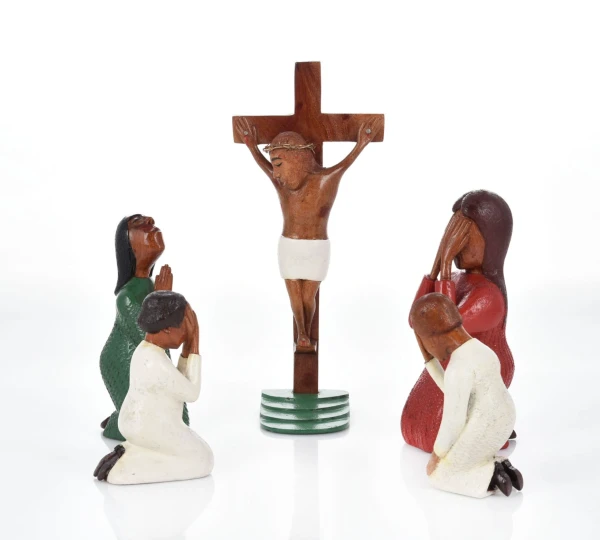
The Crucifixion,
Painted Carved Wood,
2004
The remarkable master woodcarver Johannes Mashego Segogela (1936 – 2018) is a significant figure in the aesthetic history of 20th-century South Africa. A visionary artist, Segogela’s striking evangelical sculpture-making went hand in hand with the saving of souls.
Segogela, born in 1936 in Sekhukhuneland in the Limpopo Province, then the Northern Transvaal, first came to Johannesburg to work in construction as an electrician, then as a welder, and later as a boilermaker. From 1954, he became an active member of the Church of Five Missions, and from the early 1980s, inspired by his fervent religious conviction, he began making sculptures, using the skills he had learnt in the building trade. His masterfully carved and painted figurines, of wood from the monoko tree, are concerned with political, social, and foremostly religious themes.
A faithful and devout Christian, Segogela used angelic and satanic tableaux to produce theatrical critiques of apartheid politics and policies, with depictions of the devil frequently standing in for the Nationalist government. His sculptures of the everyday, alongside the divine, became his instruments for saving the world from senseless violence and damnation.
Segogela’s subject matter ranges from cosmopolitan-looking couples in their business attire to scenes of everyday life, to direct quotations from the Bible and feverish happenings of devils feasting on sinners. Throughout Segogela’s work, there is a particular South African question of church and state. Through his depiction of secular everyday life, he sought to understand the Manichean struggle between good and bad; between the devil and the angels of God. Segogela’s two deep and unwavering commitments – the ANC and Christianity – were the force behind his artmaking. His work is bound up with the contemporary dilemmas and crises of late-apartheid South Africa, whilst engaging with the notions of revelation and redemption.
Collected and feted by maverick gallerist and art dealer Linda Givon of the Goodman Gallery, Segogela had a conspicuous career during his lifetime. Givon held numerous solo presentations of his work in Johannesburg, and he was part of various significant exhibitions during the 1990s, including the Venice Biennale (1993) and Big City, at the Serpentine in London (1995). He has been included in the landmark publications of revisionist South African art history: Steven Sack’s The Neglected Tradition from 1988, Sue Williamson’s Resistance Art in South Africa, from 1990, and Sue Williamson and Ashraf Jamal’s Art in South Africa from 1996. The sculptor is part of institutional collections in South Africa and across the world, most notably the Fowler Museum, UCLA, and the Brooklyn Museum in the United States.
Today, all internet sources claim Segogela is still living; upon his death in 2018, there were no announcements or obituaries. He has had no place in recent scholarship, and little detailed information on his life has been published. During the first decades of his career as an artist, Segogela sat in the uneasy and contentious category of what was historically called transitional art, a designation that reveals more about the structures of exclusion under apartheid than about the artists themselves. Today one can situate Segogela as an outlier artist. As curator and art historian Lynne Cooke, notes that an ‘outlier is an individual or an agent or an entity that is at a distance from an aggregate, so from the norm’. And suggests that those artists who function outside the so-called mainstream, due to a contextual condition in which they work, could now be considered to work from a place of strength rather than weakness. Cooke, curator of the landmark exhibition Outliers and the American Vanguard Art at the National Gallery of Art, Washington, states: ‘self-taught artists – variously termed folk, primitive, visionary, naïve, and outsider – have played a significant role in the history of modernism, yet their contributions have been disregarded or forgotten.’ Whilst time and time again over the last century, artists of the “mainstream” ‘found affinities and inspiration in the work of their untutored, marginalised peers and became staunch advocates, embracing them as fellow artists.’
Segogela’s sculptures evoke a biographic–otherworldly hybrid through his depiction of both the everyday and illustrations of his faith. These figures in communion are often poignant allegorical narratives. The recurring angel with a video camera figure symbolises divine documentation during Apartheid. At first glance, the figurines perhaps have an ornamental or naive quality, but they are powerful vehicles for moral and political messages, exposing human brutality and divine intervention.
It is with enormous pleasure that I present the first incarnation of Old and Interesting Art elsewhere from its usual location on Great Russell Street in London, in Cape Town. Great appreciation and thanks go to Between Us, the inimitable Jesse & Jamie, for allowing me to make this exhibition in their space. Segogela speaks directly to Old and Interesting Art’s programme, which focuses on artists with radical vision whose practices challenge conventional boundaries and offer divergent interpretations. Segogela’s dogmatic use of metaphor and religious doctrine reveals him as a sculptor of profound conviction, whose work remains completely urgent today.

Johannes Segogela, Devil Eating a Sinner, Carved and Painted Wood

Johannes Segogela, Couple, Carved Painted Wood